01T+00:00
Casualty event at the front
A casualty occurs on the forward edge: combat zone, contested industrial site or remote disaster area. Position is fixed, the alert goes out. The clock starts.
Five operational steps turn a standard medical kit into a configured, drone-delivered prolonged casualty care capability. Every step is timed, documented and reproducible across operator skill levels.
In certain types of warfare, getting medical logistics to the patient is the challenge. Denied areas, because of terrain, weather, the type of warfare or other circumstances, are sometimes simply not reachable with conventional medical and logistical means. Ambulances cannot get close enough, there is no air superiority so helicopters cannot fly, the area is saturated by drones, or the only road into a disaster area is cut.
Large-scale combat operations can combine all of these problems, and evacuation may then take 24 hours or more. Timely care is the basis of military medicine; modern conflicts put the medical timeline under pressure.
When helicopters cannot fly and ambulances cannot approach, evacuation can stretch well beyond doctrinal timelines, in some scenarios to 24 hours or more. Prolonged casualty care then becomes a realistic requirement.
Haemorrhage control, airway management and early resuscitation are time-critical. The kit's screen activates on opening and sequences these first steps for the responder immediately.
Electronic warfare means live telemedicine cannot be assumed. Guidance has to work on the kit itself, with no uplink at all.
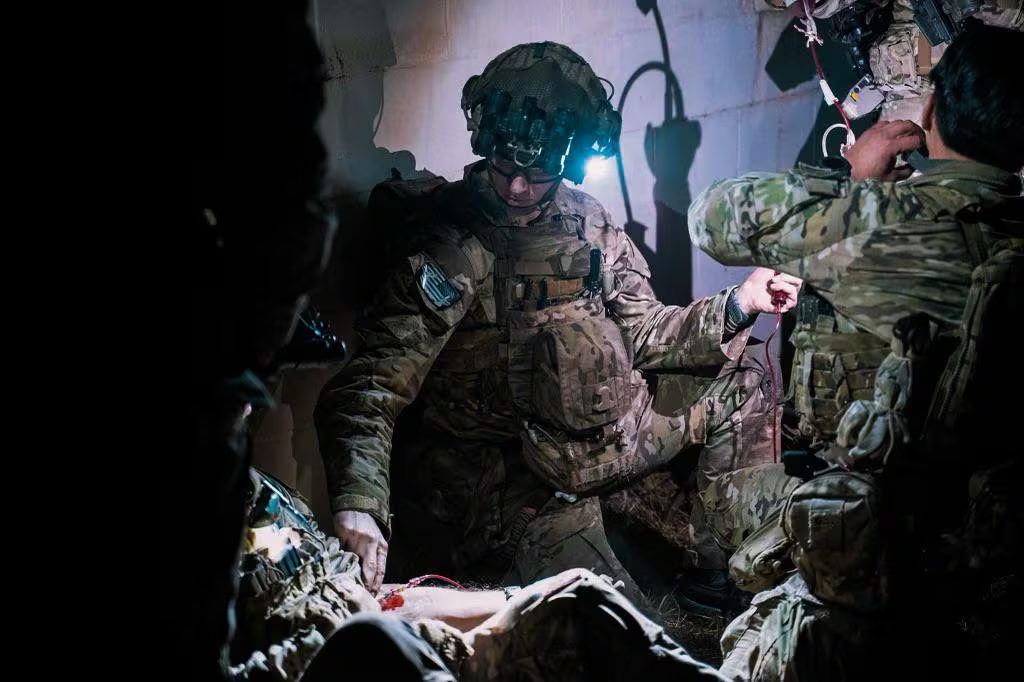
The first person on scene is a buddy, a soldier or a volunteer with limited medical training. They need to act correctly, in the right order, under pressure.
Timeline adapted from NATO AJMedP-1 and JTS prolonged casualty care guidance. In contested environments the distance between Point of Injury and a medical facility may be short, yet evacuation may still take many hours.
Basic equipment, stabilisation, limited advanced care and preparation for evacuation. ResCura Tactical extends what Role 1 can do when evacuation to Role 2 is delayed beyond doctrine.
Five operational steps turn a standard medical kit into a configured, drone-delivered prolonged casualty care capability. Every step is timed, documented and reproducible across operator skill levels.
A casualty occurs on the forward edge: combat zone, contested industrial site or remote disaster area. Position is fixed, the alert goes out. The clock starts.
The first responder opens the ResCura kit. The screen activates and walks them through haemorrhage control, airway and breathing in the correct order, following TCCC / MARCH and ABCDE.
Two different messages leave the point of injury. The 9-line is the evacuation request (location, radio, number and precedence of patients, equipment, security, marking). The MIST report is the medical summary (Mechanism, Injuries, Signs, Treatment given). ResCura Tactical keeps them apart and supports each differently.
Time-stamped log of the guided steps completed; MIST summary compiled from the logged treatment and the vitals entered; time and position of the incident.
Mechanism and injuries, vital signs, and the 9-line fields (number of patients, precedence, security, pick-up site). The 9-line is sent through the unit's normal radio procedure.
Automatic transmission of the MIST summary and position to medical command over 4G / LTE-M where uplink exists; automatic vital-sign capture; live telemedicine with bidirectional video.
Based on the MIST summary, the medic at command configures a ResCura Tactical Aegis kit for this specific casualty: blood products, intraosseous access, advanced airway, medication. Case-specific protocol steps and dosages are loaded onto the kit's touchscreen before dispatch.
The configured kit flies directly to the casualty's coordinates, bypassing routes that are blocked or under fire. On arrival the first responder opens it and the pre-loaded protocol takes over: vascular access, transfusion, airway, continued resuscitation and documented monitoring until evacuation, which may still be hours away.
Brings structured protocols and configured materials to the point of injury.
Activates on opening and sequences the first interventions when evacuation is delayed.
Step-by-step guidance for haemorrhage control, airway, breathing and reassessment, logged as performed.
Enables non-medics to follow advanced protocols with guidance and documented handover.
The problem statement and the protocol logic behind ResCura Tactical follow NATO medical planning doctrine, the TCCC and JTS clinical practice guidelines and the published evidence on time to resuscitation.
One form, one reply from the defence team within two working days. Prefer e-mail or phone? Both are listed next to the form.